
Real estate lead generation: the complete playbook for agents
The complete real estate lead generation playbook: buyer vs seller leads, valuation magnets, open house capture, speed-to-lead, listing landing pages, and a 30-day launch plan.
Why real estate leads are a different game
High ticket, long cycle, local trust, and brutal response-speed math. Generic lead generation advice loses money here.
A real estate lead is not a software trial signup. It is the start of a decision worth tens of thousands in commission, made once every 5 to 10 years, by someone who chooses one agent out of a handful in a specific geography.
That shapes everything. First, the decision cycle is long: a lead captured today may transact in 3 to 12 months, so nurture beats blitz. Second, the lead volume is low and the value is high, so the cost of one mishandled lead is enormous. Third, geography is the product: an agent who wins a zip code beats an agent who wins the internet.
The fourth difference is the one that quietly kills most agent marketing: buyers and sellers are two different businesses. Most agents treat them as one funnel and end up with a page, a message, and a follow-up sequence that serve neither.
- High ticket, low frequency: one lead can be worth thousands
- Long decision cycle: nurture is not optional
- Local trust wins: geography beats reach
- Buyer and seller funnels must be built separately
The lead math: know your numbers before you spend a minute
Real estate marketing fails quietly because agents judge channels by lead count instead of by cost per appointment and cost per closing. Fix the scoreboard first.
Illustrative math for one channel: 100 leads at a 10 percent appointment rate gives 10 appointments; a 50 percent appointment-to-client rate gives 5 clients; a 2 out of 5 closing rate gives 2 transactions. If 2 transactions pay 14,000 total, you now know exactly what a lead in that channel is worth: 140. Every channel can be judged against that number.
Write your own version of this chain: leads to appointments, appointments to agreements, agreements to closings. Once it exists, cheap-but-junk leads become visible, and expensive-but-serious leads become obviously worth it.
Agents do not fail from too few leads. They fail from not knowing which leads were worth anything.
- Track the chain: lead -> appointment -> agreement -> closing
- Value each channel by cost per closing, not cost per lead
- A 140-worth lead makes a 30 lead cheap and a 200 lead expensive
- Review the chain monthly per channel
Buyer leads vs seller leads: build two funnels
Buyer leads are easier to get and worth less directly: they are more numerous, lower commitment, and often months away. Seller leads are rarer, harder to earn, and pay both sides of the eventual deal.
The practical structure: buyer funnels trade immediate value (listings, alerts, guides) for contact info. Seller funnels trade confidence (valuation, pricing strategy, prep plans) for a conversation.
Run both, but know which one each asset serves. A generic home search page that converts buyers will quietly do nothing for listings. A valuation magnet does nothing for buyers. Two pages, two messages, two follow-ups.
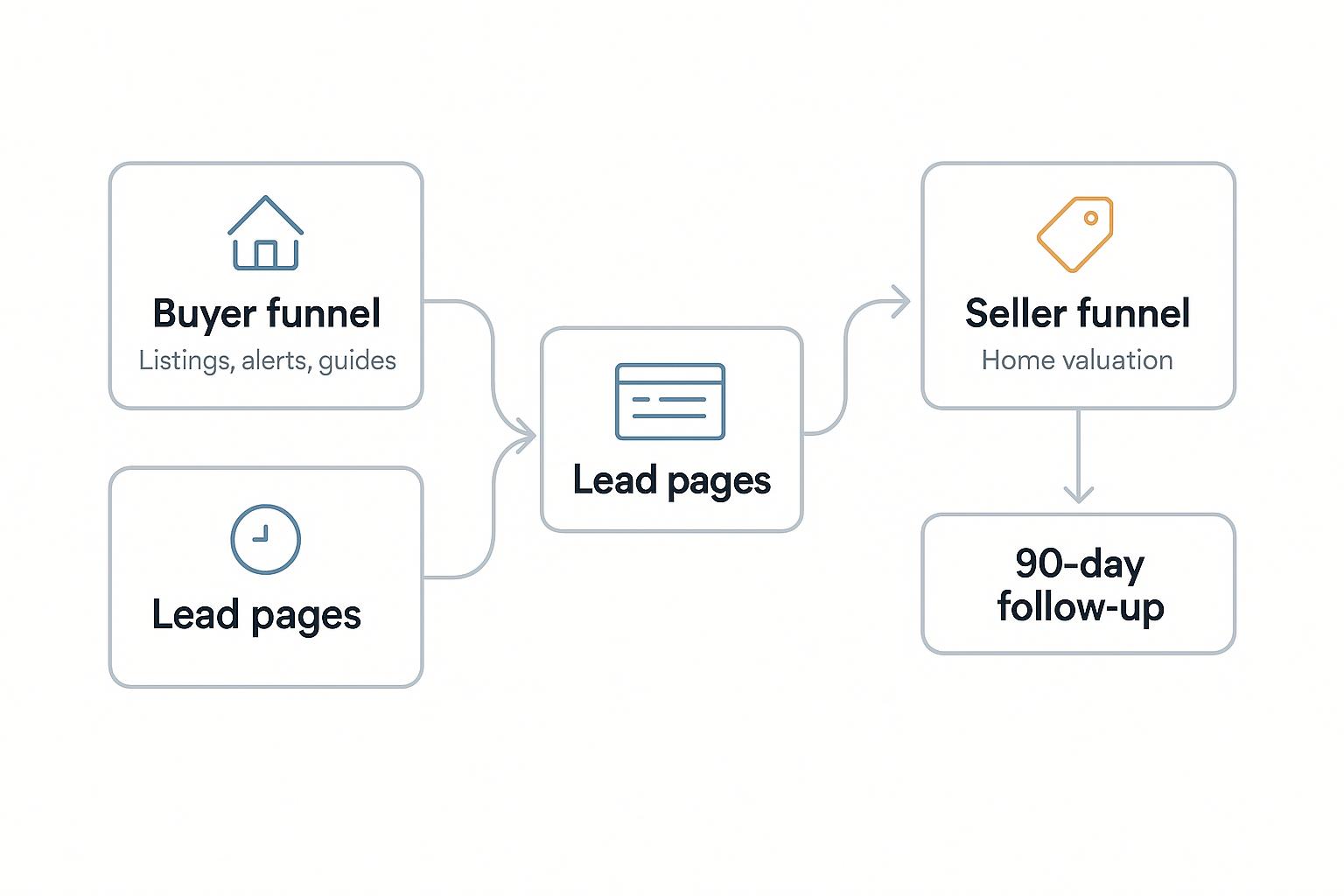
- Buyer funnel: listings, alerts, neighborhood guides, financing help
- Seller funnel: valuation, pricing strategy, staging and prep, timeline
- Separate landing pages and separate follow-up sequences
- Prioritize seller funnels once volume allows: they pay double
The single highest-converting real estate offer: the home valuation
Of all real estate lead magnets, the free home valuation consistently converts best, because it answers the question every homeowner secretly asks: what is my home worth today?
The valuation lead is a seller lead by definition. Someone requesting one is thinking about selling, refinancing, or a life change. Even the just-curious segment warms up fast when nurtured with neighborhood price updates.
Make it credible and specific: state what they get (an estimated range, comparable sales, and a short call to review it), keep the form short (address, name, email, phone optional at first), and promise a human follow-up, not an instant robot number.
- Promise: estimated value range + comparable sales + 15-minute review call
- Form: address, name, email; phone after trust
- Say what happens next, in one sentence, above the button
- Follow up with a real person within hours, not a generic PDF
Listing-specific landing pages beat your homepage every time
Every listing is a lead capture opportunity, and most agents waste it by linking property ads and social posts to a homepage or a portal profile they do not own.
A listing landing page carries the address promise end to end: photos, price, key facts, a tour-booking form, and similar-listings capture for the people who came for this house but will buy a different one. Address-matching is why it converts: the visitor clicked on 12 Maple Drive, so 12 Maple Drive is what they must see in one second.
The secondary capture is the quiet money-maker: an email field for similar homes in the area. Many of the best buyer relationships start on a listing that was never the right house.
- Hero: address, price, first photo, tour-booking form above the fold
- Body: facts, neighborhood context, agent credibility line
- Capture 2: similar-listing alerts for visitors who bounced off this home
- Link every ad, post, and QR code to this page, never to a homepage
Speed to lead: the 5-minute rule
Real estate leads decay faster than almost any other industry because buyers and sellers inquire with several agents at once and often hire whoever responds first with something useful.
The working rule: respond within 5 minutes when possible, within the hour at absolute worst. The first useful response, a quick text with the address, two photos, and one question, beats a polished email sent the next morning.
Build the system, not just the discipline: instant autoresponder confirming receipt and setting expectations, mobile notification on every new lead, and a text-first template library ready to personalize in 30 seconds.
- Target: first response in 5 minutes, always within 60
- Instant confirmation with realistic next-step timing
- Text beats email for first contact on listing and valuation leads
- Prepare 5 response templates: listing inquiry, valuation, open house, general buyer, general seller
Channel: open houses, engineered as capture machines
Open houses produce the highest-intent buyer traffic an agent can physically stand in front of. Most agents waste it with a paper sign-in sheet nobody fills honestly.
Engineer the flow: a QR code at the door opening a 3-field mobile form (name, email, buying timeline) with instant confirmation, a follow-up text the same evening with the disclosure packet and comparable homes, and a second-touch email 48 hours later with similar listings.
Neighbors are the hidden prize: 3 to 5 households near any listing are usually thinking about selling within a year. Door-knock or drop a one-pager during every open house, with a valuation offer and your face on it.
- QR to a 3-field form; disclose exactly what they get for signing in
- Same-evening follow-up with real materials, not a thank-you note
- 48-hour second touch with similar listings
- Neighbor flyer with valuation offer during every open house
Channel: local search and your Google Business Profile
Buyers search homes on portals, but they search agents on Google: best realtor near me, how to choose a real estate agent, homes for sale in [neighborhood]. Owning those results is owned lead flow that no portal can take.
Your Google Business Profile is the storefront: complete every field, collect reviews after every closing with a direct review link, post market updates weekly, and point the profile's website button to a page that captures, not a page that introduces.
Neighborhood-level content compounds: one genuinely useful guide per farm area, covering real prices, timelines, and buyer mistakes, outranks generic citywide blog filler because it answers the actual question.
- Complete profile, review engine running after every closing
- Weekly market-update posts with one local data point
- Profile website button -> lead capture page, not the about page
- One deep neighborhood guide per farm area, updated quarterly
Channel: farm area strategy that actually works
Farming still works, but the modern version is proof over presence. Calendars, notepads, and door hangers are presence. The farm wins on demonstrated local expertise, visible monthly.
The minimum effective farm system: a monthly one-pager or email with that neighborhood's actual numbers (new listings, sales, median price movement, one notable sale), delivered consistently to 200 to 500 doors or inboxes for at least 12 months.
Add one seller-focused lead page for the farm, with the neighborhood name in the headline. What is your [Maplewood] home worth converts farm residents at multiples of a generic citywide valuation page because relevance is pre-built.
- 200-500 doors or inboxes, one neighborhood, 12 months minimum
- Monthly proof: real numbers, not motivational postcards
- Farm-specific valuation page with the neighborhood in the headline
- Track farm-attributed leads in your source column
Channel: social video, short and local
Short video is the cheapest trust-building medium agents have, and it needs no production polish: a phone, a listing, and 45 seconds of useful commentary.
Three formats carry most results: listing walkthroughs with one honest observation per video, market updates with one number and one implication, and buyer or seller tips answering one question each. Every video ends by pointing to one capture asset: the listing page or the valuation page.
Consistency beats reach. Three videos a week for six months turns a quiet profile into a local referral source, and the comments become warm leads you can move into text conversations.
- Format 1: listing walkthrough, one honest observation
- Format 2: market update, one number, one implication
- Format 3: one buyer or seller question answered
- Every video points to one capture page; profile link does the same
Channel: sphere and past clients, the compounding asset
Past clients and sphere contacts already trust you, which makes them the cheapest leads and the best referral engine you will ever build. Most agents lose them to silence, not to competitors.
The system is a calendar, not a campaign: a useful touch every month (market snapshot for their neighborhood, a home-maintenance note, a tax-assessment heads-up), a genuine check-in every quarter, and a review ask plus referral nudge at natural moments after closings.
Give your sphere a forwardable asset: a valuation page link they can hand a friend who mentions moving. Referrals flow through the lowest-friction path you provide.
- Monthly useful touch, quarterly personal check-in
- Review ask at every closing, referral nudge at every check-in
- Forwardable valuation link for friends-who-are-moving moments
- Tag your database by neighborhood for relevant updates
Nurture: the 90-day cadence for leads who are not ready
Most captured leads are months from transacting. That is not a problem; it is the pipeline. The problem is agents who contact once and disappear.
A workable 90-day cadence: week 1, the fast human follow-up and one useful asset. Weeks 2 to 4, one value message per week (market snapshot, buyer checklist, comparable sales). Weeks 5 to 12, a biweekly rhythm mixing neighborhood data with one soft invitation to talk. Day 90, a direct no-pressure check-in with a specific question about timeline.
Every message earns the next open by being about the lead's situation, not your production. The cadence converts because persistence plus relevance beats charisma.
- Week 1: human contact + one useful asset
- Weeks 2-4: weekly value (data, checklists, comparables)
- Weeks 5-12: biweekly, value with one soft invite
- Day 90: direct timeline question, permission to pause or continue
Real estate landing page anatomy: what must be on the page
Real estate buyers and sellers carry industry-specific doubts: is this agent licensed and local, do they actually sell in my area, what happens after I submit. A converting page answers them in order.
The structure that works: hero with the specific promise (the address, or the neighborhood valuation), a credibility strip (license, transactions closed in this area, review count), proof near the form (two or three real review quotes), a process line (what happens after submit, in one sentence), and a form that asks the minimum with one qualifying question (timeline, or buying vs selling).
Leave out everything else. Market jargon, award badges without dates, and long bios do not convert; specificity does.
- Hero: specific promise with address or neighborhood name
- Credibility strip: license, local transactions, review count
- Two or three real review quotes near the form
- One sentence: exactly what happens after submit
- Form: minimum fields + one timeline qualifier
Measure what matters: source, speed, and appointments
Three numbers tell the whole story: where leads come from, how fast you respond, and how many become appointments. If source is unknown, add a form field or ask in the first message; self-reported attribution is imperfect but honest enough to steer budget.
Speed tracking is free: timestamp each lead and each first response. Most agents who measure it discover their real response time is hours, not minutes, and fixing that alone lifts appointment rates.
- Every lead tagged by source and funnel type (buyer/seller)
- Track time-to-first-response per source
- Count appointments booked, not leads collected
- Review cost per closing by channel monthly
The 30-day launch plan
One month from generic presence to a running lead system.
Week one, build the two capture points: a valuation page for sellers and one listing-style page template for buyers. Set up lead notifications to your phone and the five response templates.
Week two, seed the system: link the valuation page in your profiles and email signature, publish the first neighborhood guide, and set up your Google Business Profile review link after your next client interaction.
Week three, activate the physical channels: run the QR open-house flow at your next showing, drop the first farm one-pager, and record your first three short videos pointing to the pages.
Week four, start the cadence: send the first sphere market snapshot, begin the 90-day nurture for every lead captured this month, and set a weekly 30-minute review of sources, speed, and appointments.
- Week 1: valuation page + listing template + response templates
- Week 2: profile links + first neighborhood guide + review engine
- Week 3: QR open-house flow + farm drop + first videos
- Week 4: sphere snapshot + nurture cadence + weekly review ritual
Hard scenarios and what to do
Scenario one: portal leads dominate but convert terribly. Portals sell the same lead to several agents, so speed and specificity decide it. Respond in minutes with property-specific value, and rebalance effort toward owned assets, valuation pages and farm content, where nobody competes with you for the lead.
Scenario two: good traffic, weak form fills. The page is speaking generic. Put the neighborhood or address in the headline, move one review quote next to the button, and cut the form to three fields. Test one change per week.
Scenario three: leads reply once and go silent. The follow-up is about you, not them. Switch the cadence to lead-specific value: their neighborhood numbers, their comparable sales, their timeline question. Silence usually means irrelevant, not uninterested.
- Portal leads: win with speed, rebalance toward owned channels
- Traffic without fills: specificity, proof placement, form length
- Silent leads: relevance repair before frequency increase
Common failure patterns in real estate lead generation
- One generic funnel pretending to serve both buyers and sellers
- Ads and posts pointing to a homepage instead of the listing or offer page
- Response times measured in days while competitors respond in minutes
- Open houses with paper sign-in sheets and no follow-up plan
- Farm presence without farm proof: postcards with no numbers
- Social video about awards and lifestyle instead of one useful answer
- Capturing leads with no nurture cadence behind them
- Judging channels by lead count instead of cost per closing
Own the capture, win the zip code
Portals own buyer attention, but you can own the capture points that turn attention into relationships: the valuation page, the listing page, the open house flow, the farm newsletter, and the follow-up system that stays in contact for 90 days and beyond.
None of it requires a big budget. It requires two focused pages, a response discipline, and a calendar you actually keep. The agents who build these assets stop renting leads and start compounding them.
Start with the seller valuation page. It is the highest-converting offer in the industry, and everything else in this playbook plugs into it.
Frequently asked questions
How much should I spend to generate real estate leads?
Judge spend by cost per closing, not cost per lead. Map your chain from leads to appointments, appointments to agreements, and agreements to closings, then compare every channel's cost per closing against the commission it produces.
How fast should I respond to a new real estate lead?
Within 5 minutes when possible, and within 60 minutes at worst. Buyers and sellers inquire with several agents at once, and the first useful response usually wins the conversation.
Are buyer leads or seller leads more valuable?
Seller leads are rarer and more valuable because one listing pays both sides of the eventual deal. Buyer leads are easier to attract and convert faster. Build both funnels and prioritize sellers as volume allows.
Do I need a separate landing page for each listing?
Yes. Address-specific pages match the visitor's intent, convert far better than a homepage, and capture secondary leads through similar-listing alerts for visitors who came for one home but will buy another.
How long does organic lead generation take to work?
Expect about 30 days to build the system and 60 to 90 days for compounding results. Organic leads become cheaper every month you stay consistent.
About the author
Yarden Gabay is the founder of Bizabee, an AI marketing platform for small teams. He writes about lead generation, landing pages, and the marketing systems that help small businesses grow without big budgets.