
How to generate leads without paid ads: the organic lead engine
A complete framework for generating leads with zero ad budget: organic search, local presence, communities, referrals, and email, with a 30-day launch plan.
The honest math of zero-budget lead generation
Organic leads are not free. They cost time, consistency, and patience. But once the engine runs, each lead gets cheaper every month.
Paid ads buy attention today. Organic systems build attention that keeps paying next quarter. If your budget is zero, you are not choosing between good and bad marketing. You are choosing between channels that cost money and channels that cost effort.
Here is an illustrative comparison. A small business spending 800 per month on ads might buy 40 leads at 20 each. The same 800 as 10 hours per week of focused organic work produces almost nothing in month one, maybe 15 leads in month two, and 40 to 80 leads per month by month four, with the cost per lead falling toward zero as the assets keep working.
That second line only becomes true if the work is structured. Random posting, occasional blogging, and hoping for referrals is not an engine. An engine is a small set of repeatable channels, each with one asset, one distribution habit, and one capture point.
- Ads: leads now, cost per lead stays flat or rises
- Organic: leads later, cost per lead keeps falling
- Hybrid: use early ad revenue to fund organic patience
What actually converts organic visitors into leads
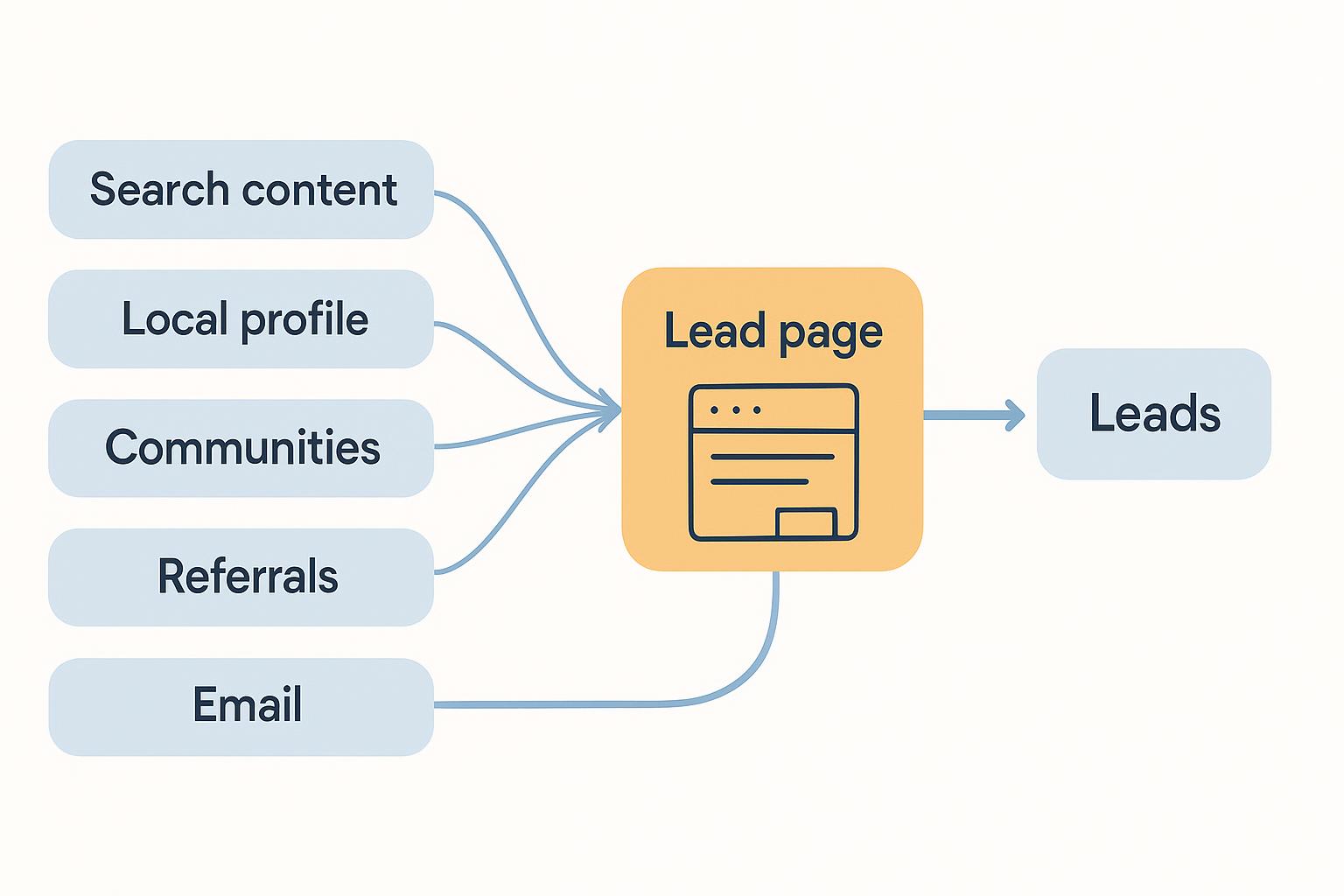
Every organic channel ends at the same place: a page that captures contact information in exchange for something valuable. If the capture page is weak, every channel upstream leaks.
This is the most common zero-budget failure. Teams work hard on content, community posts, and referral asks, then send everyone to a generic homepage with a contact form buried in the footer.
Before you build any traffic, build one focused lead page per offer. One promise, one proof block, one form, one clear next step. This single asset multiplies the output of every channel in this guide.
Channel 1: search content that answers buying questions
Search is the highest-intent free channel because people arrive already describing their problem. The mistake most small teams make is writing about themselves instead of writing about the questions buyers actually type.
Buyers search in three layers. Awareness questions describe symptoms: why is my roof leaking. Comparison questions describe options: flat roof repair vs replacement cost. Decision questions describe choosing: best roofing contractor near me how to choose.
Decision and comparison questions convert. Awareness questions build audience. A small business should publish mostly comparison and decision content, because you do not need volume, you need the 50 people per month who are already choosing.
- List the 20 questions your best customers asked before buying
- Prioritize questions that include words like vs, cost, best, how to choose
- Answer the question fully in the first screen, then go deeper
- Add a next-step CTA that matches the question stage
- One focused article per question beats ten shallow posts
Channel 2: local presence for businesses with a service area
If you serve a geography, your fastest organic channel is not your website. It is your Google Business Profile and the review ecosystem around it.
A complete profile with regular updates, photos, service details, and a steady flow of reviews can produce calls and form submissions within weeks, because local results have far less competition than general search.
Treat the profile like a mini landing page: the offer in the description, the proof in the photos, the next step in a booking link that goes to your lead page, not your homepage.
- Complete every profile field, including services and service area
- Ask for a review after every successful job, with a direct link
- Reply to every review, positive or negative, within 48 hours
- Post weekly: one offer, one before/after, or one common question
- Point the booking or website button to a focused lead page
Channel 3: communities where your buyers already gather
Communities, groups, and forums are the fastest feedback loop in organic marketing. They are also the easiest to get wrong, because groups punish promotional behavior quickly.
The working pattern is give-first visibility. Answer questions thoroughly, share frameworks and checklists without asking for anything, and become a recognized name over 4 to 8 weeks. When people start tagging you into threads, that is when a soft offer or a profile link starts converting.
Your profile is your ad space. A one-line description of who you help plus a link to your lead page does the selling for you while you do the helping.
- Pick 2 communities max: depth beats coverage
- Answer 3 to 5 questions per week with real substance
- Publish one original framework or checklist per month
- Never link your offer unless the thread invites it
- Track profile visits and lead-page referrals as your metric
Channel 4: referrals and partnerships with built-in trust
Referrals convert better than every other channel because trust arrives pre-installed. The problem is that most small businesses treat referrals as weather: something that happens to them.
Engineer it instead. Define your ideal referral partner as a business that serves the same customer before or after you do, with no competing offer. A wedding photographer, a florist, and a venue all serve the same customer in sequence.
Then make referring you effortless: a short message they can forward, a lead page link with their context in mind, and a reciprocal rule. You refer to them first, visibly, and the loop closes itself.
- List 10 businesses that touch your customer before or after you
- Reach out with reciprocity: promote them first, no strings
- Give partners a simple forwardable intro message and link
- Ask happy customers for one specific intro, not generic referrals
- Thank every referral source the same day it arrives
Channel 5: email, the only channel you own
Every other channel in this guide lives on rented land. Algorithms change, groups moderate, search rankings move. Email is the one list nobody can take from you.
For a zero-budget system, email does two jobs. It converts existing organic visitors who are not ready to buy yet, and it reactivates past leads who went quiet. Both are free revenue.
A minimum viable email engine is one weekly message: one useful insight, one proof point, one clear action. Consistency matters more than brilliance. The list that hears from you weekly buys; the list that hears from you quarterly forgets you.
- Capture emails with a specific resource, not a generic newsletter
- Send one useful message per week, same day, same format
- Segment by interest once you pass a few hundred subscribers
- Revisit leads who went quiet after 30, 60, and 90 days
- Measure replies and clicks, not just opens
The 30-day organic engine launch plan
One month to go from zero to a running system. Each week has one job.
Week one is infrastructure. Build one focused lead page for your primary offer, set up your Google Business Profile completely, and write your community profile descriptions. Nothing goes live yet except the page and the profile.
Week two is search seed. Publish your first two decision-stage articles from the question list. Set up a simple tracking sheet for leads by source so you can see, from day one, which channel actually produces.
Week three is distribution. Start the 2-community answering rhythm, send your first partner reciprocity messages, and launch the weekly email to whatever list exists, even if it is 20 past customers.
Week four is review and compounding. Check lead sources, double down on whatever produced, cut whatever produced nothing, and schedule next month's two articles. The engine's second month is now mostly maintenance.
- Week 1: lead page live, profile complete, tracking sheet ready
- Week 2: two decision-stage articles published
- Week 3: communities active, 5 partner outreach messages sent
- Week 4: review by source, double down, schedule month two
How to measure organic leads without fancy tooling
Zero budget does not mean zero measurement. A simple spreadsheet beats an analytics setup nobody checks.
Record every lead with three fields: source, offer, and outcome. Source answers where they came from. Offer answers what they responded to. Outcome answers what happened in sales. Within 60 days, the source column tells you exactly where to invest more hours.
For digital capture, add one question to your form or follow-up: how did you find us. Self-reported attribution is imperfect but surprisingly honest, and it costs nothing.
- Three fields per lead: source, offer, outcome
- Review sources weekly for the first two months
- Ask how did you find us in every follow-up
- Count qualified conversations, not just raw submissions
Hard scenario: effort is high, leads are zero
If you are executing consistently for 8 weeks and nothing converts, the problem is almost always one of three things, in this order of likelihood.
First, capture page mismatch: traffic arrives with one intent and the page speaks a different language. Fix the page headline to mirror the exact words your traffic uses.
Second, wrong-stage content: you are answering awareness questions when readers need decision help, so visitors get informed and leave. Shift toward comparison and choosing content with a matching CTA.
Third, offer strength: people understand the content but do not want the next step badly enough. Test a lower-commitment action, like a free audit, template, or estimate, before concluding the channel is dead.
- Check page-to-traffic message match first
- Then check whether content stage matches buyer stage
- Then test a lower-commitment offer
- Only after all three: reconsider the channel
Common failure patterns to avoid
- Posting everywhere shallowly instead of going deep in two places
- Sending organic traffic to a homepage instead of a lead page
- Publishing awareness content and wondering why nobody converts
- Quitting at week six, right before compounding starts
- Treating referrals as luck instead of engineering a loop
- Collecting emails without ever sending a useful message
- Measuring vanity activity (posts, impressions) instead of leads
When ads start making sense again
Organic and paid are not enemies. The right sequence for most small teams is organic first, ads second.
Once your lead page converts organically at a healthy rate, small ad tests become efficient: you are paying to pour traffic into a machine you already know works. Without that base, ads amplify a leaky system and every lead gets more expensive.
The practical trigger: when your organic cost per lead is documented and your page converts consistently, allocate a small test budget against the exact offer and audience that already worked organically.
- Prove the offer converts with free traffic first
- Then test ads against the same audience and page
- Keep the organic engine running; it lowers blended cost per lead
Build the capture point first, then feed it
Every channel in this guide, search content, local presence, communities, referrals, and email, ends at the same door: a focused lead page with one promise and one action.
Teams that build the capture point first and then feed it channel by channel see compounding results. Teams that scatter effort across channels with no capture point see activity without leads.
Start with the page. Then run the 30-day plan. By month two, the question is no longer whether organic leads are possible. It is which channel to double.
Frequently asked questions
Can you really generate leads without paid ads?
Yes. Search content, local presence, communities, referrals, and email all produce leads without ad spend. The cost is time and consistency instead of money, and each lead gets cheaper as your assets compound.
How long does organic lead generation take?
You can launch the full system in 30 days. Expect meaningful results in month two and compounding growth by month three or four if you stay consistent.
What is the fastest organic channel for a local business?
Your Google Business Profile. A complete profile with steady reviews and weekly posts can produce calls and form submissions within weeks, because local results have far less competition than general search.
Where should organic traffic be sent?
To a focused lead page with one promise and one action, never a generic homepage. The capture page is what turns every channel's traffic into leads.
About the author
Yarden Gabay is the founder of Bizabee, an AI marketing platform for small teams. He writes about lead generation, landing pages, and the marketing systems that help small businesses grow without big budgets.