
25 lead magnet ideas that actually convert (and how to build one)
25 lead magnet ideas grouped by funnel stage, the five rules that separate magnets that convert from PDFs nobody opens, and a one-day build plan.
What a lead magnet actually is (and what it is not)
A lead magnet is a specific, immediately useful resource exchanged for contact information. Everything else is a form nobody fills.
The definition matters because most failed magnets fail on specificity. A guide titled The Complete Guide to Marketing asks for an email and promises homework. A checklist titled The 12-Point Launch Checklist promises a tool usable in the next ten minutes.
People do not trade their email for information. Information is free everywhere. They trade it for a shortcut: something that saves time, removes a decision, or prevents an expensive mistake.
The exchange is also a promise of future value. If your follow-up never delivers it, the magnet produced a subscriber but not a lead, and the list decays into unopens.
- Magnet: specific, immediately usable, solves one narrow problem
- Not a magnet: a long PDF that reads like a blog post
- The email is the price; the magnet must feel like a bargain
The five rules of magnets that convert
Rule one: one audience, one problem. A magnet for everyone converts nobody, because specificity is what makes someone feel it was written for them.
Rule two: promise a result, not a topic. 12 prompts that book more consultations beats Introduction to AI for Sales.
Rule three: consumable in under 15 minutes. Long magnets signal effort. Short, dense tools signal respect for time.
Rule four: proof inside. One example, screenshot, or before/after inside the asset does more than a polished cover.
Rule five: a natural next step. The magnet should make your paid offer the obvious continuation, not a hard pivot. A checklist for planning a service should end where your service begins.
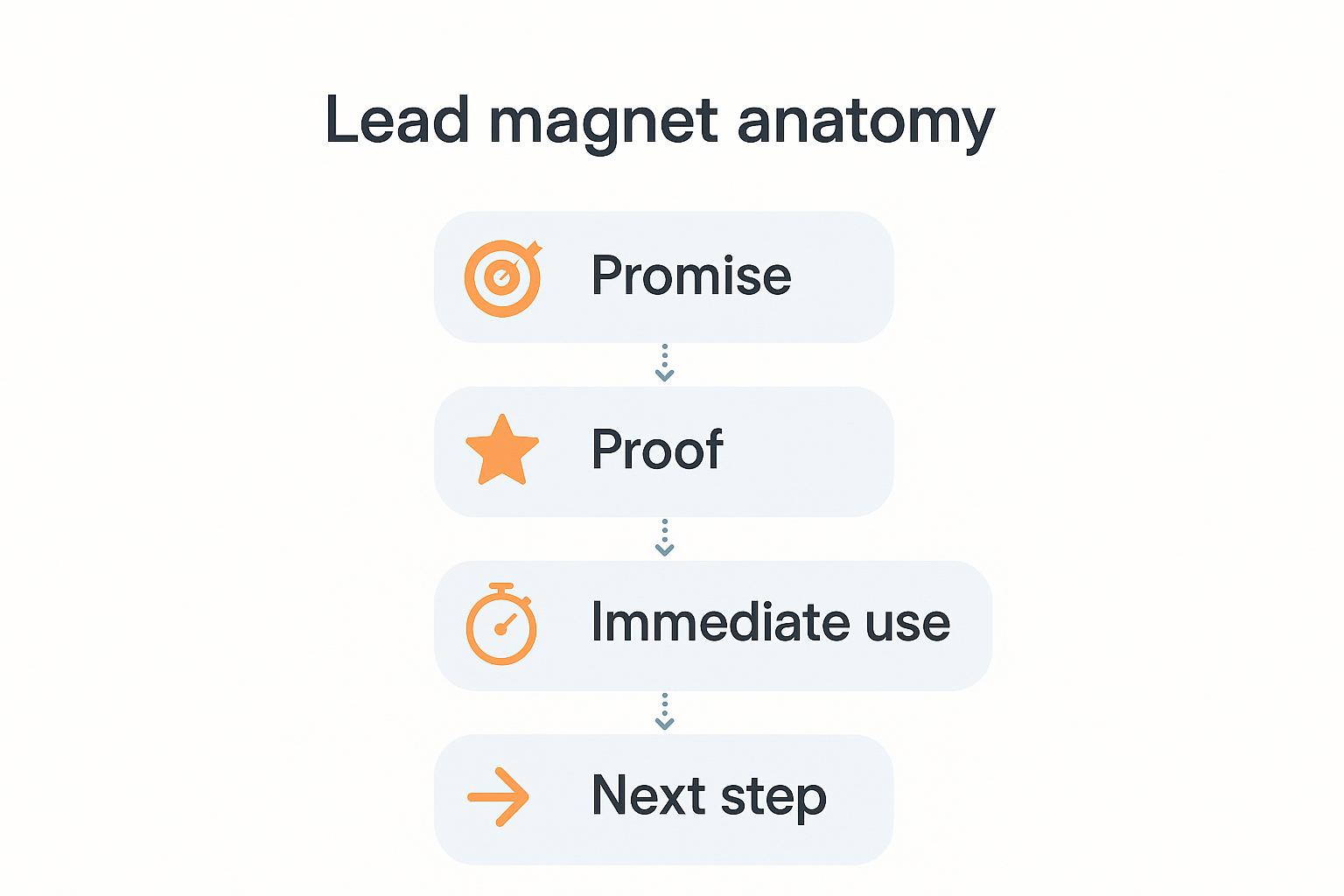
- One audience, one problem, one promise
- Result-oriented title with a number
- Usable in under 15 minutes
- Includes one proof element
- Ends where your offer naturally starts
Magnets for the top of funnel: attract and capture
Best for audiences that do not know you yet. Lower commitment, higher volume.
These magnets trade a small piece of value for a first touchpoint. They work when volume matters more than immediate sales intent, for example when building an audience for weekly email.
- 1. Checklist for a task your buyer does repeatedly: The 12-Point Website Launch Checklist
- 2. Cheat sheet: one-page reference for a process, like a posting schedule framework
- 3. Template: fill-in-the-blank email, brief, or proposal people would otherwise write from scratch
- 4. Swipe file: 10 real examples of something done well, annotated with why each works
- 5. Quiz with personalized results: score your funnel, get your grade and two fixes
- 6. Resource list: the 15 tools and links you actually use, with one-line usage notes
- 7. Calendar or planner: a 30-day content or launch planner as a spreadsheet
- 8. Mini email course: 5 days, one lesson per day, each ending in one action
Magnets for the middle of funnel: qualify and build trust
Best for visitors comparing options. Higher perceived value, better lead quality.
Middle-funnel magnets attract people who are actively evaluating. They answer real decisions, which is why leads from this group convert to sales conversations at higher rates.
- 9. Calculator or spreadsheet: pricing estimator, ROI calculator, budget planner
- 10. Comparison guide: your category explained honestly, including when you are not the right fit
- 11. Audit checklist: self-assessment that reveals gaps your service fills
- 12. Workbook: guided worksheet that takes someone through planning their own project
- 13. Recorded teardown: you reviewing a real example (site, ad, menu, portfolio) and fixing it
- 14. Sample deliverable: a redacted real proposal, report, or design people can inspect
- 15. Decision tree: one-page flowchart for choosing between options in your category
- 16. Prompt pack: copy-paste AI prompts for a job your buyer does weekly
Magnets for the bottom of funnel: convert ready buyers
Best for people close to a purchase. Lower volume, highest sales conversion.
Bottom-funnel magnets should look like your service in miniature. The person who uses them well is the person most likely to buy the full version.
- 17. Free tool with a paid ceiling: a working tool where your service is the upgrade
- 18. First-step service: free draft, estimate, audit, or strategy session with a defined scope
- 19. Case study pack: three detailed before/after stories with numbers and timelines
- 20. Onboarding preview: exactly what working with you looks like, week by week
- 21. Pricing guide: real ranges, what changes the price, and how to budget
- 22. Objection pack: honest answers to the 10 questions buyers ask before signing
- 23. Trial with a guided first win: not a demo, a 20-minute setup that produces one real result
Magnets most small businesses overlook
The answer bank doubles as sales enablement: every answer your team writes once becomes a magnet, a follow-up email, and a faster sales reply.
The failure guide outperforms success stories because loss aversion moves faster than aspiration. People will trade an email to avoid a 5,000 mistake faster than to chase a 5,000 gain.
- 24. Answer bank: the 30 questions your sales inbox gets, answered properly
- 25. Failure guide: the 7 mistakes that cost buyers money in your category, and how to avoid each
How to pick the right idea instead of a random one
Score every candidate idea against three questions. Who exactly is it for? What result do they get in the first 15 minutes? What is the natural next step toward your offer?
Then apply the inbox test: if you received this magnet as an email attachment from a stranger, would you open it? If the honest answer is no, the idea is too generic.
Finally, pick the magnet you can build in one day. A mediocre magnet shipped this week beats a perfect magnet planned for next quarter, because every week without capture is a week of leaking traffic.
- Audience: can you name the exact person?
- Result: is the first win within 15 minutes?
- Continuity: does it end where your offer starts?
- Speed: can you ship it in one day?
Build the magnet in one day: the schedule
Morning: outline from your real work. Take the last five customer conversations, extract the questions, mistakes, and steps they actually went through. This is the raw material; it is why real magnets feel different from generic ones.
Midday: build the core asset only. No branding project, no cover design marathon. A clean document or spreadsheet with one job done well.
Afternoon: add one proof element (a real example, screenshot, or anonymized result), write the landing page for the magnet itself, and set up the delivery: form, instant access, and one follow-up email that delivers a bonus tip.
Evening: test the full flow on your phone, from ad or link click to download to follow-up. Every friction point you feel, a visitor abandons.
- AM: mine five real customer conversations
- MD: build the core asset, nothing else
- PM: proof element + magnet landing page + delivery flow
- PM: full mobile test, remove every friction point found
The magnet landing page is half the conversion
A strong magnet behind a weak page converts like a weak magnet. The landing page for the magnet needs four things and nothing more.
The promise: the specific result, stated as the magnet title, repeated in the button. The proof: one line of credibility or one screenshot of the actual asset. The exchange: exactly what happens after the email, in one sentence. The form: email only until you have a reason to ask for more.
Resist adding navigation, company stories, or secondary CTAs. Every extra link on a magnet page reduces the one action that matters.
- Promise as title, repeated on the button
- One proof line or real screenshot of the asset
- One sentence explaining what happens after submit
- Email field only, no phone unless the offer demands it
Distribution: where magnets get traffic for free
Two of these done consistently outperform all six done once. Pick profile links plus one community or content-upgrade channel and run them for 60 days before judging results.
- Link in your social profiles, with the result in the text
- Answer relevant community questions and offer the magnet as the full version
- Add it as a content upgrade inside related blog articles
- Include it in your email signature and every follow-up template
- Offer it to referral partners as something useful to share with their clients
- Mention it in your Google Business Profile posts
Measure the magnet, not just the downloads
Download count is a vanity number. A magnet with 40 downloads and 5 sales conversations beats one with 500 downloads and zero conversations.
Track four numbers: opt-in rate on the page, percentage who actually open the asset, replies or clicks on the follow-up email, and sales conversations that mention the magnet. The second number is the one nobody measures and the one that predicts everything.
If open-rate-of-asset is low, the magnet promised more than it delivered. If opt-in is low, the page is the problem. If conversations do not mention it, the magnet attracts readers, not buyers, and the next version needs bottom-funnel intent.
- Opt-in rate: page and promise quality
- Asset opened: magnet quality
- Follow-up engagement: list quality
- Sales conversations: funnel fit
Common failure patterns to avoid
- Building a magnet nobody asked for instead of mining real conversations
- A 40-page PDF that took three weeks and gets skimmed once
- A generic Complete Guide title that promises homework, not results
- Collecting emails with no follow-up email written
- A magnet page cluttered with navigation and competing links
- Judging the magnet on downloads instead of conversations
- Shipping one magnet and never testing a second angle
Start with one magnet, one page, one channel
The businesses that generate leads from content are not the ones with the most ideas. They are the ones with one specific magnet, one focused page, and one distribution channel run consistently for 60 days.
Pick the idea from the lists above that scored best on the four selection questions. Build it in the one-day schedule. Put it on a focused lead page. Then distribute it through one channel until the data tells you where to go next.
The first magnet rarely wins. The system that produces the second and third one quickly is what wins.
Frequently asked questions
What is a lead magnet?
A specific, immediately useful resource exchanged for contact information, such as a checklist, template, calculator, or mini course. The email is the price; the magnet must feel like a bargain.
How many form fields should a lead magnet page have?
Ask for email only until you have a reason to ask for more. Every additional field lowers conversion, and qualification can happen later in follow-up.
What makes a lead magnet convert well?
One audience, one problem, a result-oriented promise, consumption in under 15 minutes, proof inside the asset, and a natural next step toward your paid offer.
How should I deliver a lead magnet after signup?
Instantly: immediate access plus one follow-up email that adds a bonus tip. Delay or complexity kills trust at the exact moment you promised value.
How do I know if my lead magnet is working?
Track four numbers: opt-in rate on the page, whether subscribers open the asset, engagement with the follow-up email, and how many leads turn into sales conversations.
About the author
Yarden Gabay is the founder of Bizabee, an AI marketing platform for small teams. He writes about lead generation, landing pages, and the marketing systems that help small businesses grow without big budgets.