
40 AI prompts for small business marketing (copy, adapt, ship)
40 copy-paste AI prompts for marketing: strategy, landing pages, content, email, social, ads, and analysis, with the prompt formula that makes any prompt work.
Why most AI marketing prompts produce generic output
The problem is almost never the tool. It is that the prompt lacks the four inputs every good output needs.
A prompt like write a blog post about our service gives the model nothing to aim at, so it aims at average. Average is what you get when the audience, offer, voice, and constraint are all unspecified.
Good prompts share the same anatomy. Who the output is for. What the business actually offers and why it wins. How the brand sounds, with an example. What format and length the output must fit, plus what to avoid.
The 40 prompts below are written to be adapted: each one has slots to fill with your specifics. The formula matters more than the wording, so learn it once and every prompt in your notebook improves.
- Audience: who reads this and what they want
- Offer: what you sell and the honest reason it wins
- Voice: one or two example sentences that sound like you
- Constraint: format, length, and explicit things to avoid
The context block: write it once, reuse it forever
Before using any prompt below, write a 5-line context block and paste it at the start of every session. This one habit improves output quality more than any clever phrasing.
Line one: what the business does and for whom. Line two: the primary offer and its price point. Line three: the main differentiator stated honestly. Line four: two sentences of real brand writing. Line five: who we never try to sell to.
Keep the block in a note and update it quarterly. It is the difference between an assistant that knows your business and one that guesses.
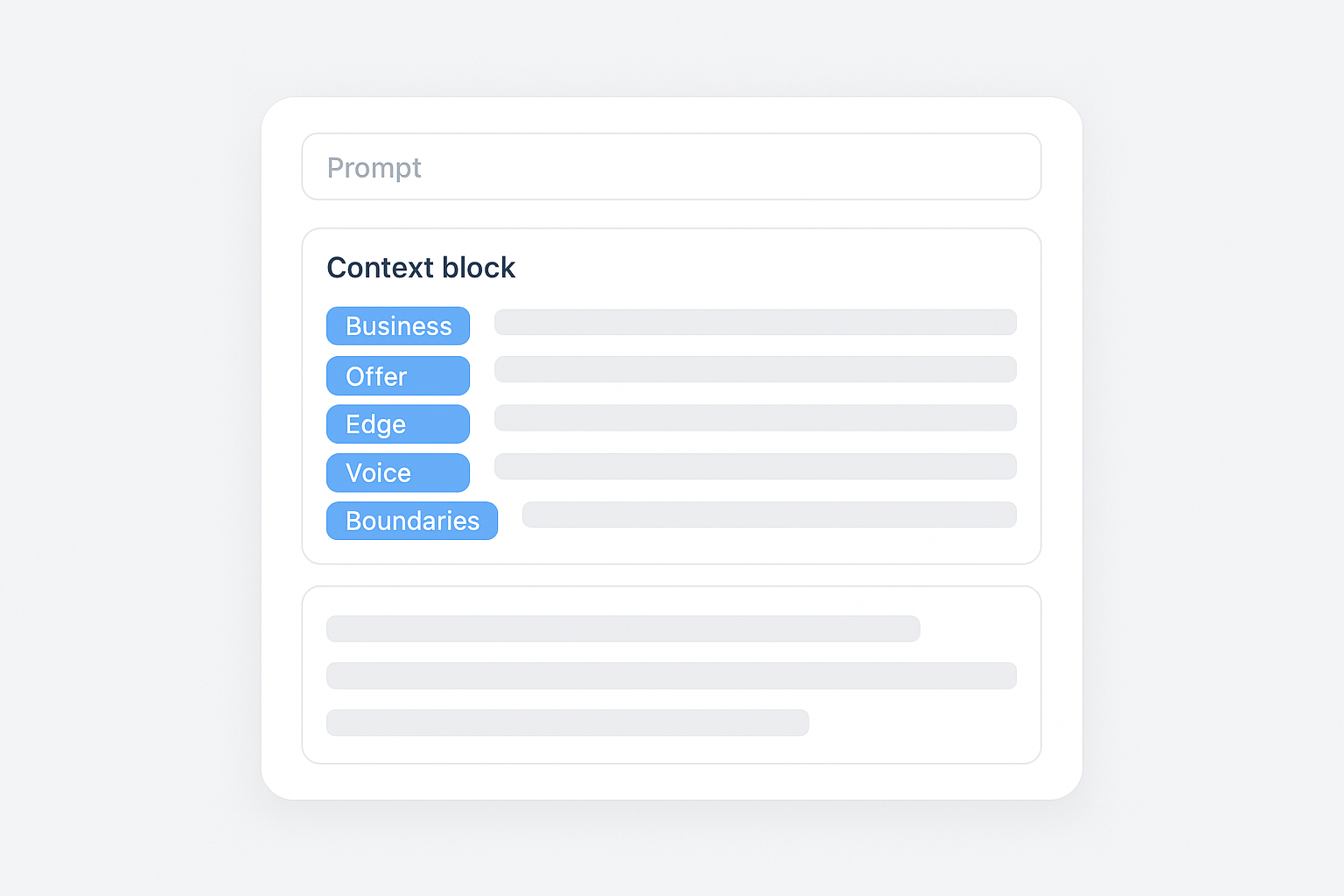
- Business: what + for whom
- Offer: primary product and price point
- Edge: the honest differentiator
- Voice: two real example sentences
- Boundaries: who the offer is not for
Strategy prompts (1-6)
Use these monthly. They turn vague goals into plans you can execute.
Fill the brackets with your context block details. If an output feels generic, the fix is almost always more specific brackets, not a new prompt.
- 1.
Act as a marketing strategist for [business type] serving [audience]. Our primary offer is [offer] at [price]. List the 5 marketing systems we should build this quarter, ranked by expected impact per hour invested, with one reason each. - 2. `Here is our current positioning: [paste]. Rewrite it in 3 versions: one focused on speed, one on risk reduction, one on cost. Keep each under 25 words.`
- 3.
List the 10 questions our ideal customer [audience] asks before buying [category]. Mark each as awareness, comparison, or decision stage. - 4. `Our top competitor is [competitor]. Compare our offer [ours] vs theirs in a table: target customer, pricing, strengths, and 2 gaps we could own.`
- 5. `Create a 30-day marketing plan for [business] with zero ad budget. Channels available: organic content, Google Business Profile, email list of [size], and 2 communities. One action per day, 60 minutes max.`
- 6. `Review this quarter's results: [paste metrics]. Diagnose the single biggest bottleneck (traffic, conversion, or retention) and prescribe one fix per week for 4 weeks.`
Landing page and offer prompts (7-14)
The highest-money prompts in this list. Pages pay for everything else.
Landing page copy fails when it describes the product instead of the reader's outcome. These prompts force outcome language and explicit next steps.
- 7.
Write 10 headline options for a landing page selling [offer] to [audience]. Each headline states one concrete outcome and stays under 10 words. No puns, no buzzwords. - 8. `For this headline: [chosen headline], write a 2-sentence subheadline that answers: what is it, who is it for, and what happens next.`
- 9. `Write the hero section for [offer]: headline, subheadline, primary CTA button text, and 3 trust bullets. Audience: [audience]. Tone: [voice examples].`
- 10.
List the 6 objections [audience] has before buying [offer]. For each, write one reassurance line we can place near the form. - 11.
Write a Who this is for / Who this is not for block for [offer]. Be specific and honest; the not-for list should disqualify real mismatch cases. - 12. `Outline a landing page for [offer] with section-by-section purpose: relevance, proof, process, risk reduction, and decision. One line per section describing what it must accomplish.`
- 13. `Rewrite this form intro microcopy to reduce friction: [paste current text]. Keep it under 15 words and answer why we need the information.`
- 14.
Write 5 versions of our primary CTA button for [offer], ranging from low commitment to high commitment. Label the intent level of each.
Content and SEO prompts (15-22)
Use these weekly. They keep publishing consistent without sacrificing intent.
The strongest content prompts start from real buyer questions, not from a topic list. Combine prompt 15 with prompt 3 above for a full month of content ideas.
- 15.
Generate 20 article titles answering real questions [audience] types into search about [category]. Mark each as awareness, comparison, or decision intent. - 16. `Create a brief for the article: [title]. Include target query, search intent, outline with H2s, 5 questions to answer, and one CTA for [offer].`
- 17. `Write the article intro for [title]: 3 paragraphs, answer the core question in the first paragraph, hook a [audience] reader, no throat-clearing.`
- 18. `Turn this article: [paste] into 8 social posts. Each: one idea, one takeaway, under 280 characters. Vary formats: stat, contrarian take, checklist, question.`
- 19. `Rewrite this section: [paste] to be 30% shorter without losing a single concrete detail. Remove adjectives, keep specifics.`
- 20. `Write an FAQ section for [offer page]: 8 questions our [audience] actually asks, each answered in 2 sentences max.`
- 21. `Suggest the 5 internal links we should add to this article: [paste], given these other pages: [paste titles/slugs].`
- 22.
Give this draft a headline and 3 alternative titles optimized for the query [target keyword]. Keep each under 60 characters.
Email prompts (23-28)
The cheapest revenue prompts. One good sequence runs for years.
Email prompts work best when you paste a real customer conversation as raw material. The model extracts patterns from reality far better than it invents from a description.
- 23.
Write a 5-email welcome sequence for new subscribers who downloaded [magnet]. Email 1 delivers the promised value, emails 2-4 teach one thing each, email 5 introduces [offer]. Under 150 words each. - 24. `Write a weekly newsletter template for [audience]: one insight, one proof point, one action. Make the structure repeatable with fill-in slots.`
- 25. `Turn this customer email thread: [paste] into a friendly FAQ-style email we can send to all customers who ask the same thing.`
- 26. `Write a 3-email re-engagement sequence for leads who went quiet after asking about [offer]. No guilt, no pressure. Email 1: new proof. Email 2: new resource. Email 3: clear close-out.`
- 27. `Subject lines: write 10 for an email about [topic] to [audience]. Under 45 characters, specific, no clickbait. Label the psychology of each (curiosity, utility, urgency).`
- 28. `Rewrite this email: [paste] in our brand voice: [voice examples]. Keep the same message, cut 30% of the length, end with one clear action.`
Social media prompts (29-33)
Use these to turn one win into a week of posts.
Social prompts perform best when fed real material: a customer result, a before/after, a lesson learned. Ask the model to extract stories, not to invent them.
- 29. `Here is a customer win: [describe result]. Turn it into 3 posts: a story version, a numbers version, and a lesson version. Under 150 words each.`
- 30. `Create a 7-day posting plan for [platform] for [business]: each day one post idea with hook, body, and CTA. Mix education, proof, and behind-the-scenes.`
- 31. `Write 5 hooks for a post about [topic]. Each hook: under 12 words, creates a curiosity gap without clickbait.`
- 32. `Rewrite this post: [paste] for [platform]. Add a hook in the first line, break into short paragraphs, end with one question that invites replies.`
- 33.
Generate 10 comment-starting questions we can ask [audience] about [topic]. Avoid yes/no questions; each should invite a specific answer.
Ads and copy prompts (34-37)
Even a small ad budget gets cheaper with better copy inputs.
Ad prompts should produce variants for testing, not one perfect ad. Ask for labeled variations so each version tests one assumption.
- 34. `Write 6 ad variants for [offer] targeting [audience]: 2 pain-led, 2 outcome-led, 2 proof-led. Each: headline under 40 characters, body under 90 words, CTA.`
- 35. `Here is our best-performing ad: [paste]. Write 5 variants that change exactly one element each: headline, proof, offer framing, CTA, audience callout.`
- 36.
Write 3 Google Ads headlines and 2 descriptions for [offer] and query [keyword]. Include the keyword in each headline, stay within character limits. - 37. `Review this ad: [paste]. List the 3 weakest claims and rewrite each to be specific and believable, with what proof we would need to show.`
Analysis and research prompts (38-40)
The most underrated prompts. They turn the data you already have into decisions.
Paste real material: form responses, sales call notes, reviews, support threads. The model is most valuable as a pattern finder over your own reality.
- 38. `Here are 20 customer inquiries: [paste]. Cluster them into themes, count each theme, and tell us the top 2 things to address on our landing page.`
- 39. `Summarize these reviews: [paste] into: what customers praise most, what they complain about, and 3 improvements worth prioritizing.`
- 40. `Here are our last 30 days of metrics: [paste]. Identify trends, flag one anomaly worth investigating, and recommend one experiment for next week with a success threshold.`
How to feed context properly: the 3-layer method
Layer one is the standing context block from earlier in this article. It goes first, every session.
Layer two is the task input: the real material the prompt needs, such as customer quotes, current copy, metrics, or competitor examples. Real material beats descriptions of real material; paste the actual thing.
Layer three is the output contract: format, length, tone, and exclusions. State what to avoid explicitly. AI models handle negative constraints surprisingly well when they are concrete: no buzzwords, no exclamation marks, under 90 words.
- Layer 1: standing context block (5 lines)
- Layer 2: real material pasted, not described
- Layer 3: output contract with explicit exclusions
Guardrails: where AI must not run unsupervised
The rule that keeps quality high: AI produces the first 80 percent at 10x speed, and your judgment produces the last 20 percent that makes it yours. Teams that skip the last 20 percent publish content that reads like everyone else's, and search engines and buyers both notice.
- Claims: every number, stat, and guarantee needs human verification
- Pricing and policy: never let AI invent commitments you have not approved
- Customer names and data: strip or anonymize before pasting anything sensitive
- Voice: AI drafts, you finalize; your last-mile edits are the brand
- SEO: publish nothing you have not read fully and improved once
A weekly AI workflow that fits in 2 hours
Session one, 60 minutes, Monday: run prompts 15, 16, and 18 to plan the week's article, draft its brief, and pre-produce its social versions.
Session two, 60 minutes, midweek: run prompts 7-9 for any page or offer work, prompt 24 for the weekly email, and prompt 40 for last week's numbers.
Everything gets one human pass before publish. Two hours of AI-assisted sessions plus two hours of editing produces what used to take a full week.
- Monday: content plan + brief + social cutdowns
- Midweek: page copy + weekly email + metrics review
- Always: one full human pass before anything publishes
Common failure patterns to avoid
- Prompting without the context block and wondering why output feels generic
- Describing material instead of pasting the real thing
- Publishing AI drafts without the final 20 percent human pass
- Asking for one perfect version instead of labeled variants for testing
- Pasting confidential customer data into tools without anonymizing
- Chasing clever phrasing instead of fixing missing context
Save the formula, not just the prompts
The 40 prompts in this article will age. The anatomy behind them will not: audience, offer, voice, and constraint in, quality out.
Build your own prompt library the same way. Every time a prompt works, save it with its context block and note what made it work. Within a quarter you will have something more valuable than any template list: a prompt system trained on your actual business.
And remember where prompts end: the output still needs a focused page to convert on. The fastest prompt-to-revenue path ends at a lead page.
About the author
Yarden Gabay is the founder of Bizabee, an AI marketing platform for small teams. He writes about lead generation, landing pages, and the marketing systems that help small businesses grow without big budgets.