
What is a landing page and why it drives ad conversions
A complete practical guide to landing pages: what they are, why they matter, who uses them, and how they maximize ad ROI.
The short answer first
A landing page is a focused destination page built for one campaign and one action.
Most websites are made for exploration. Landing pages are made for decision. That is the key difference.
When someone clicks an ad, they arrive with context and intent. A strong landing page continues that exact context and guides the visitor to one clear next step, such as submitting a form, booking a call, or starting a trial.
If you send ad traffic to a generic homepage, users must figure out where to go next. Every extra decision creates friction. Landing pages remove that friction by narrowing options and clarifying value.
Landing page vs homepage: why this distinction matters
A homepage has many jobs: brand story, navigation, product overview, press mentions, careers, and more. It supports broad audience discovery.
A landing page has one job: convert one traffic segment for one offer. It removes unrelated pathways and prioritizes action clarity over site breadth.
Neither is better universally. They are different tools for different moments. Homepages are for browsing and credibility. Landing pages are for conversion focus.
- Homepage: multi-path browsing experience
- Landing page: single-path conversion experience
- Homepage KPI: engagement and exploration quality
- Landing page KPI: conversion rate and lead quality
Why landing pages are critical for paid ads
Paid ads compress time. You are buying attention for seconds, not minutes. If the destination is unclear, expensive clicks disappear before value is created.
Landing pages improve ad performance because they maintain message continuity from ad promise to page headline to CTA. This continuity reduces bounce and increases confidence.
They also improve measurement quality. With a dedicated page, it is easier to track events, diagnose drop-off points, and run disciplined tests without contamination from unrelated site behavior.
In practical terms, landing pages usually help teams lower cost per lead and improve signal quality for optimization algorithms.
How landing pages maximize conversions
Conversion is rarely blocked by one giant mistake. It is usually blocked by small layers of uncertainty. Great landing pages systematically remove those layers.
They do this by answering core decision questions in the right order: Is this relevant to me? Can I trust it? What exactly happens next? Is taking action safe right now?
When those questions are resolved clearly, visitors move from attention to intent with less hesitation.
- Message match: headline reflects the ad promise
- Clarity: one offer and one primary CTA
- Trust: proof near the conversion point
- Friction control: short, intentional forms
- Risk reduction: clear expectations after submit
Who should use landing pages
Landing pages are not just for enterprise advertisers. They are useful for almost any team running targeted campaigns with a measurable outcome.
Local businesses use landing pages to turn service searches into call requests. Ecommerce brands use them for offer-specific promotions. B2B teams use them for demos, audits, and pipeline generation.
Creators, agencies, SaaS teams, clinics, real estate operators, coaches, and consultants all use landing pages because focused traffic needs focused destinations.
- Local service businesses running Google or Meta campaigns
- B2B teams promoting demos, consultations, and audits
- SaaS teams driving free trial or call-booking actions
- Agencies managing multiple campaign offers
- Founders launching new offers quickly
The anatomy of a high-performing landing page
Most winning landing pages share the same backbone. The difference is how each section is tuned for audience intent and offer complexity.
Start with a strong hero that states one specific outcome. Follow with trust proof, process clarity, and a low-friction action path. Then repeat CTA after key objections are handled.
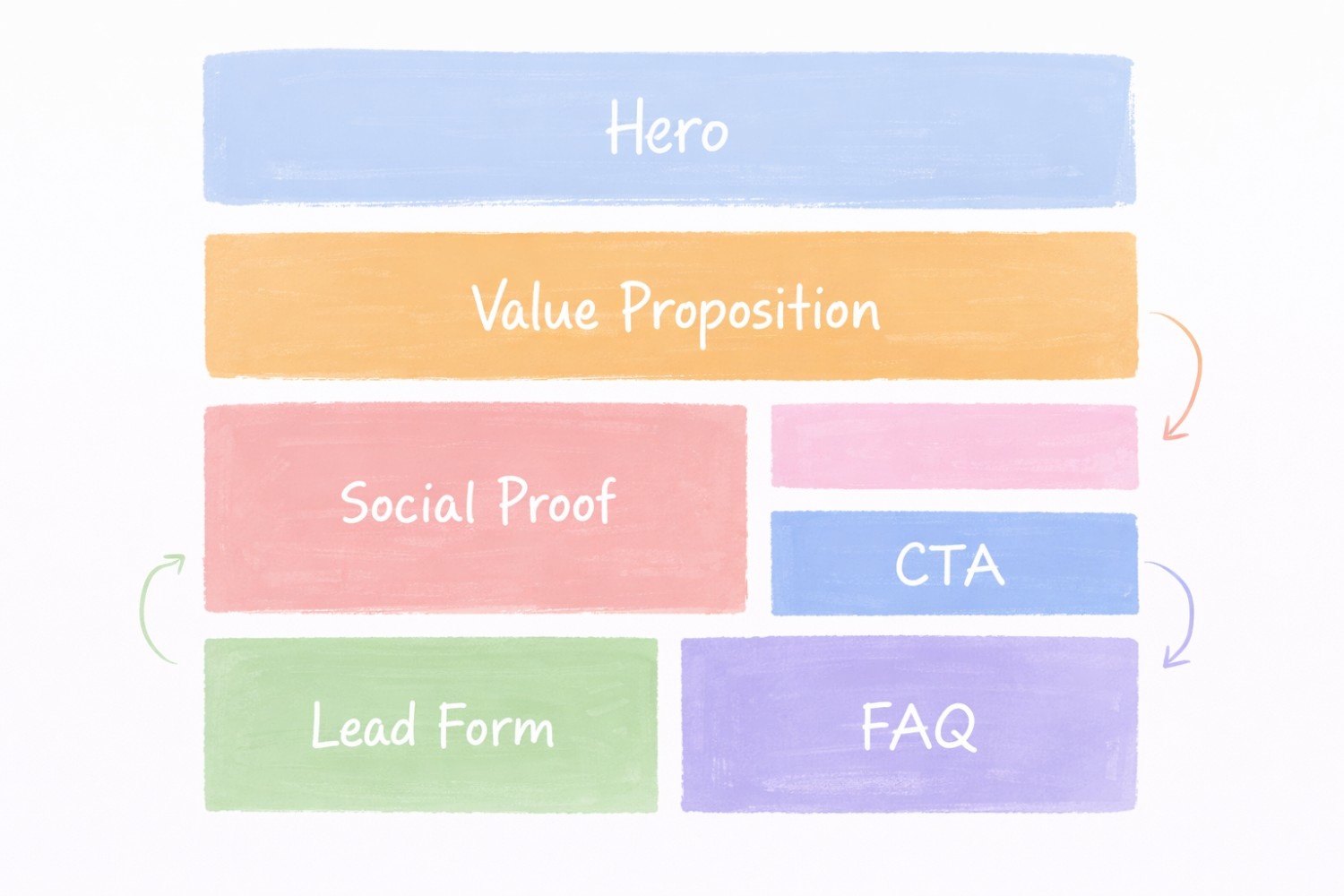
- Hero: one outcome, one audience, one CTA
- Proof block: testimonials, outcomes, or credentials
- Process block: what happens after click/submit
- Objection handling: practical reassurance
- CTA repetition: at logical decision points
Common landing-page myths that hurt performance
Myth one: shorter is always better. Short pages can convert well for simple offers, but complex or high-ticket decisions often need deeper validation.
Myth two: design is everything. Visual quality matters, but conversion usually moves most when message clarity and trust proof improve.
Myth three: one page works for all traffic. Different sources arrive with different context. Page messaging should match source intent.
Myth four: traffic volume solves conversion issues. More clicks amplify existing problems. They do not fix weak conversion architecture.
Ad-to-page message match: the highest-leverage principle
If an ad promises Same-day roofing estimate, the landing page should open with that promise or a near-identical one. If it opens with generic brand claims, trust drops immediately.
Users do not consciously think "message mismatch," but behavior reflects it: bounces rise and conversion rates fall.
Teams that maintain strict message continuity from ad copy to landing-page hero generally see better lead quality because expectations are aligned before submit.
- Mirror the core ad promise in hero language
- Keep CTA wording consistent with ad intent
- Avoid generic headlines that weaken relevance
- Repeat key promise near the form or CTA
Why landing pages are essential for ad optimization loops
Modern ad platforms optimize based on conversion signals. If your destination page is weak, signal quality is noisy and optimization gets slower or more expensive.
A focused landing page creates cleaner event data: page view, CTA click, form start, form submit, qualified lead. With clean signals, teams can make smarter budget and creative decisions faster.
This is why landing pages are not only conversion tools. They are optimization infrastructure.
- Cleaner conversion events for platform algorithms
- Faster diagnosis of where users drop off
- Better ability to compare campaigns fairly
- Higher confidence when scaling budgets
How to improve conversion without redesigning everything
You do not need a full rebuild to improve results. Most pages can improve through focused iteration.
Start with the conversion-critical layers: headline relevance, CTA clarity, proof placement, and form friction. These changes usually outperform cosmetic updates.
Run one meaningful test per cycle. For example, change headline framing while keeping the rest stable. Then review qualified lead impact, not just raw submissions.
- Upgrade headline specificity
- Tighten CTA language around one action
- Move proof closer to decision points
- Reduce first-step form fields
- Clarify what happens after submit
The quality trap: high volume, low-fit leads
Some teams increase conversion rate while hurting sales outcomes. This happens when the page optimizes for easy submissions instead of qualified intent.
To avoid this trap, define quality signals early. Include one qualification element, clear fit language, and explicit offer boundaries.
A lower raw conversion rate with stronger fit often creates better pipeline efficiency than a high-volume, low-intent page.
- State who the offer is for (and not for)
- Use one qualifying form field tied to need/timeline
- Track qualified lead separately from raw submit
- Review downstream outcomes, not top-funnel only
A practical launch checklist for any landing page
If this checklist is complete, you have a strong baseline. From there, optimize with weekly test cycles instead of random changes.
- One campaign goal and one primary CTA
- Hero message matches ad/search promise
- Trust proof visible before first form interaction
- Form asks only minimum required information
- Thank-you step confirms next steps clearly
- Tracking events implemented and tested
- Mobile experience verified end-to-end
Where Bizabee fits in this workflow
Bizabee helps teams move faster from campaign idea to conversion-ready landing page without losing message quality. You can generate, refine, and publish pages in one workflow, then track performance in the same system.
This is especially useful for small teams that need speed and consistency. Instead of juggling disconnected tools, you can keep strategy, page output, and iteration loops aligned.
When execution is easier, teams test more often. When teams test more often, conversion quality improves.
Three real-world scenarios and what to do
Scenario one: clicks are high, form submissions are low. This usually means your page has relevance but weak trust or high friction. Start by tightening proof placement near the form and reducing required fields. Then test CTA wording that clarifies immediate value after submit.
Scenario two: submissions are high, sales quality is weak. This usually means your page is attracting broad curiosity, not buying intent. Clarify fit in your headline and add one qualification element tied to urgency, budget range, or use case. Do not optimize only for submit volume.
Scenario three: results fluctuate week to week with the same budget. This usually means execution inconsistency: ad message and page message drift, or page edits are made without structured testing. Lock one weekly review rhythm and one single-variable test rule so learning compounds.
Across all scenarios, the strongest discipline is simple: keep one clear promise, one clear action, and one clear measurement loop.
Final perspective: landing pages are conversion systems, not just web pages
A landing page is not a design asset you publish once and forget. It is a living conversion system connected to your traffic, offer, and sales process.
The teams that win treat landing pages as operating assets: they launch quickly, measure honestly, and improve continuously.
If you run ads and care about lead quality, landing pages are not optional. They are one of the highest-leverage parts of your growth engine.
About the author
Yarden Gabay is the founder of Bizabee, an AI marketing platform for small teams. He writes about lead generation, landing pages, and the marketing systems that help small businesses grow without big budgets.